 PipelineScientists
Search Marketer - A Marketer for the Post-AGI age
There is a peculiarly shaped hole in every B2B technology company marketing team which has been there since the dawn of B2B tech but has become more noticeable after AI. I'm talking about the need for a marketer who can actually tell the business what to do.
In my actually orthodox opinion, marketing as a discipline had one primary job which took a backseat after the rise of "Attribution" and "Predictable Revenue" playbooks which emphasized lead generation above everything:
The job of market research. Shocker!
It used to be that marketers spent an inordinate amount of time studying their customers, learning their language, finding market gaps, and then making bombastic presentations to the CEO about where to invest next. We see it in movies and TV shows that narrate how the best businesses in history worked, like Ferrari, Heinz, etc. Something like that probably still happens in the "Big B2C" land though I'm not sure. I think it does; B2C is the older brother of B2B who figured out, a long time ago, that the only enduring advantage is a brand. And a brand is built by ... Lord knows what exactly.
Rambling aside, the need for a marketer just like that has become all the more painful after AI because AI did to B2B tech what factories and industrialization and mass media did to B2C not-tech. No one really knows where things are going, and this was precisely the place where Marketers were supposed to help -- instead they're getting laid off!
So, that's where we are.
What Exactly is a "Search Marketer"
Glad you asked.
For the last 5 years, I've consulted dozens of early stage startups and advised mid-stage software firms and done some startups of my own. My work has invariably involved positioning consultancy (obviously), channel selection (naturally), team building (inevitably), and a huge recurring amount of market research (surprisingly).
And it never stops. Even when the positioning is "figured out" and the channels are known, and we've got all our playbooks, the only recurring work left is constant market research. In fact, even the process of getting to the right positioning and channels involves a lot of ... market research.
However, It doesn't stop at market research. Anyone can prompt Claude to do an entire TAM analysis or SWOT (do people even do that anymore?) or my favourite, PULL Hypothesis, and generate a slop grenade to throw at the execs. The real work is in taking that research, crafting an offer that can actually be taken to market, and do it quickly and cheaply enough that you have an answer within a week or two.
In other words, commercial savvy combined with digital savvy.
Why I call it "Search Marketing" instead of "Research Marketing" is because:
- Research can only be done when you have a viable direction to pursue. A Search Marketer figures out those directions, and then does the research too (cf. Psycho Cybernetics goal-oriented vs goal-deciding faculties of the human brain)
- It actually has a lot to do with SEO; it is fair to translate "E" as Everywhere now more than ever, as all platforms will tend towards a walled garden strategy to protect their data moats (cf. Reddit).
More concretely, the research involved requires a deep analysis of every viable search channel available. For example, for my dev shop clients, I'm often researching trends on Clutch, G2, Capterra, Upwork, and Fiverr, and sharing insights about which job categories are under-served. For my B2B product clients, I'm looking at trends from Google, Bing, Baidu, YouTube etc.
None of this requires deep SEO knowledge in the sense of optimising a website for ranking, but it does require a deep understanding of how people search on different platforms so you can make educated hypotheses about where your business should invest.
Go-To-Market as a Service
Ok, I'm probably overdoing nomenclature now and I definitely do not intend to introduce GTMaaS as a word (though it does have a ring to it if you think about it ... ok maybe don't).
What I've described above in terms of research is standard (or should be!) for every marketer. Though it is rarely, if ever, done. Many founders are under the mistaken assumption that only they can direct the business, so they do not like suggestions coming from one step below. And that is fine. We don't intend to battle founder egos, those wonderful critters that are too big for their own good and can lead to serendipitous outcomes occasionally. The first half of a Search Marketer's job is to be like a eunuch whispering suggestions in the ear of the emperor.
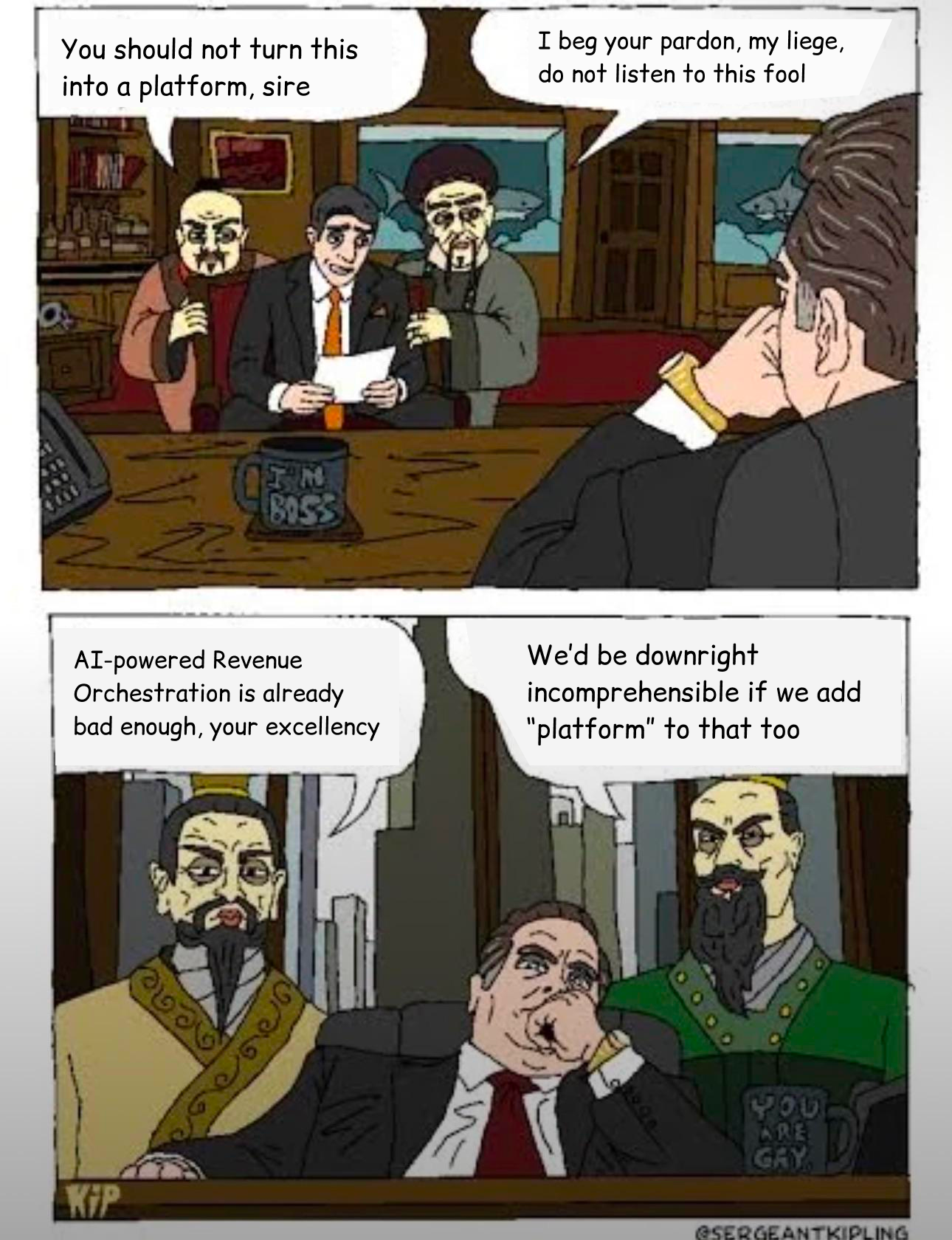
The second half is what makes the job more palatable to executives: Doing actual go-to-market.
If you just stop at research, nothing changes in the business. I can guarantee you, every single one of your suggestions, regardless of the reaction it elicited from the board room, will be ignored. In marketing more than any discipline, if you have to get shit done, you have to do it yourself.
Once you have pitched your research to the execs, made your suggestions, and have that mythical "alignment" on what to do next, you need to roll up your sleeves and execute. Quickly.
Set up a landing page, run quick paid ads, do astroturfing on Reddit, or craft a bombastic launch video -- whatever it takes to gauge the falsehood of your hypothesis. A Search Marketer should have the skillset (and the toolset) to execute all of the above single-handedly. And yes, that means she also needs to know how to run paid ads (not a rocket science), how to create landing pages (literally one prompt), astroturf on social media (let me shamelessly plug my tool), and craft launch videos (ok, this one is hard). Or whatever else may be needed.
Summarily, you have to run the initial go-to-market until you have validated that what you've suggested works. And then, you move to researching the next thing .. after delegating the work of course.
But that's just Marketing
Yes, and that is the point.
We are drowning in a sea of buzzwords and the irony is not lost on me that I'm introducing one more. Unfortunately, words become buzzwords and what they represent becomes commoditized and drifts. In many ways, every new trend in marketing -- whether it is demand generation or GTM engineer -- is an attempt to "return to form". My Ghazalian approach to reconciling this sectarianism is that ultimately, all such return to forms are about bringing one specific strand of bid'ah back to the orthodoxy.
Search Marketer is just a Marketer ultimately. But she exists uniquely in a time where she can perform all of the above quickly. And quickness is the need of the hour. The world now changes fast. Market research became a derogatory term because it used to take months. Today, you only need to tell your agent which channels to look at, what data exactly to get, maybe give it some API keys, and then wait 10 mins. Go-to-market required an entire team to design the assets, create the landing pages, craft messaging, run ads, and so on. But today, nearly all of it can be automated.
Now of course, a Search Marketer is not a replacement for a Marketing Department. The need for new discoveries is always there and if you get your hands on a good Search Marketer, you are better off utilizing her talents to always be on the lookout for new opportunities rather than waste it on running the operations on a previously proven hypothesis. To run the marketing ops for a proven hypothesis, you should have a marketing team. Or agents. Whatever floats your boat.
But the task of opportunity hunting cannot be automated, for it requires some level of "taste". And Go-to-market, despite automation, is still a very subjective endeavour whose shape is ultimately determined by the opinions of the marketer shaping them. For example, I detest wait-lists and will never do them. I'm very good at launch posts. A different marketer may be very good at wait-lists. AI is good at neither. And cannot get good at it because market tastes keep evolving and so far we do not have an AI that stays awake long enough to keep up (no, your 24/7 Hermes Agent also cannot do this for ... reasons).
Q. What about Growth Marketing. Isn't that the same?
No, a Growth Marketer's primary task is to accelerate growth from existing funnels. It is not to discover entirely new markets and offerings the way a Search Marketer does.
Q. What about Product Marketing then?
Product Marketing acts on a pre-defined audience. It decides all of its actions when the ICP is fixed. The trouble with majority businesses today is they do not even know their market. It moves so fast, any ICP you pick will have Claude as its best friend tomorrow and you become outdated. Besides, Product Marketing is limited to products. And products themselves are undergoing massive changes; for example, traditional Product Marketing does not apply effectively to agentic startups, much less Professional Services delivered by Agents. A Search Marketer's scope is broader and covers all different modalities of B2B tech -- after all, B2B tech itself is getting commoditized.
The gap still remains for a Marketer who can leverage AI to make valid hypotheses and then quickly iterate on those to guide the business in times of uncertainty, which will be a normal from now on.
Job Description of a Search Marketer
In the HR style, a Search Marketer job description is (courtesy of my friend DeepSeek):
The Role
We are looking for a Search Marketer — a commercially minded marketer who can identify market opportunities, turn them into actionable hypotheses, and personally execute rapid go-to-market tests to validate them.
This is not a traditional demand generation or brand marketing role. It is a hybrid role for someone who can combine market research, channel analysis, positioning, and hands-on execution. You should be comfortable advising leadership on where to invest, and then rolling up your sleeves to test those recommendations quickly.
The ideal candidate is part researcher, part strategist, and part builder. You can analyze how people search across different platforms, form a clear point of view on where the business should focus, and launch a practical GTM test within one to two weeks.
Key Responsibilities
1. Market and Channel Research
- Research customer needs, market gaps, and emerging opportunities across relevant search and marketplace channels.
- Analyze platforms such as Google, Bing, YouTube, Reddit, G2, Capterra, Clutch, Upwork, and Fiverr, depending on the business context.
- Understand how buyers search and evaluate solutions on different platforms, not just how websites rank on Google.
- Convert research into clear, commercially viable hypotheses and recommendations for leadership.
- Present findings and recommendations with a strong point of view, supported by evidence.
2. Rapid Go-To-Market Execution
- Once a direction is agreed, execute the initial GTM test directly.
- Build landing pages, write launch content, run paid ads, and engage in relevant online communities where appropriate.
- Validate hypotheses quickly and cost-effectively, aiming for useful answers within one to two weeks.
- Measure results, document learnings, and recommend whether to scale, refine, or stop.
- Once a hypothesis is validated, document the process and hand off ongoing execution to the marketing team or operational owners.
3. Opportunity Identification
- Continuously look for new market opportunities, underserved segments, and channel gaps.
- Maintain a strong feedback loop between market research, GTM execution, and leadership decision-making.
- Bring commercial judgment and market taste to prioritization decisions.
Required Skills and Attributes
- Commercial and digital savvy: You understand how businesses make money and how digital channels actually work.
- Strong research capability: You can analyze markets, customers, competitors, and search behavior across multiple platforms.
- Hands-on execution: You are comfortable building landing pages, running paid ads, writing launch content, and testing ideas directly.
- Search fluency: You understand how people search on different platforms and can translate that into channel and investment recommendations.
- Bias for action: You prefer fast, practical tests over lengthy planning cycles.
- Strong judgment and taste: You can form a clear opinion on what is likely to work and why. You are not dependent on generic reports or automated outputs alone.
- Executive communication: You can advise founders and senior leaders clearly, respectfully, and with evidence.
- Adaptability: You are comfortable operating in ambiguity and shifting between research, strategy, and execution.
What This Role Is Not
- It is not a pure market research role. You must be willing to execute.
- It is not a pure operations role. Once a hypothesis is validated, you should hand off ongoing execution and move to the next opportunity.
- It is not a traditional marketing management role. This is an individual contributor role focused on opportunity discovery and rapid validation.
How to Apply
Send your resume along with a short note describing:
- A market opportunity you identified in a previous role.
- How you validated it.
- What you would have done differently in hindsight.
Please also include an example of a landing page, campaign, or GTM test you personally built and executed.
Conclusion
Since identifying the need for a Search Marketer, I've been wondering if I should turn PipelineScientists into a Search Marketer firm where I personally train and produce material on Search Marketing as an entirely new discipline of marketing for the post-AGI age. At the moment, I'm somewhat on the fence about it -- not because I don't see the demand, it's just that ... man, it's hard to train people. But fine, I'll do it.
If you're looking for a Search Marketer to join your team, hit me up. I'll find you the right one. God bless and peace be upon you.
Looking for a Search Marketer, or want us to find your next market opportunity? Let's talk.