 PipelineScientists
How to build your first marketing team
Much has been written about sales and how to build a sales team. To the point where most founders make the mistake of hiring salespeople too early — it is the only non-technical role they know how to hire. And the term "sales" sound just about close enough to the biggest problem you might be facing so you default to hiring sales to fix the lack of sales.
Big mistake.
The fundamental misunderstanding is that Sales — henceforth, Sales with the capital S refers to the function and sales refers to the concept — is self-sustaining. That if you hire a salesperson, and she does some sales things, you'll get more customers.
I'll make the bold statement right now:
If you are not having at least 5 transactional meetings every week, you do not need a salesperson.
And that includes every flavour of "salesperson" — SDR, BDR, AE, what have you. To handle that volume, a single founder is enough. No need for a salesperson.
What you need is Marketing. And a specific flavour of it.
Unfortunately, marketing is an incredibly misunderstood area for founders. Most founders have no idea if they should be hiring a Content Marketer, or Digital Marketer, or Performance Marketer, or Growth Marketer, and all sorts of other terms.
In this guide, I'll share with you a mental model that I use in my consulting practice to help companies hire and organise their marketing teams and start producing enough transactional conversations that they end up hiring a salesperson to offload the work.
Let's start with the Customer
Every business has a theoretical TAM (Total Addressable Market) which consists of all their ICPs (Ideal Customer Profile). For example, my product ColdSend.pro is targeted at B2B Lead Generation Agencies. I'll carry this example to illustrate the model.
Assume there are about a 100,000 B2B Lead Generation agencies all over the world. This is my TAM.
I want, as much as possible, to be "known" by all of them. Once they know me and my offering, the next step is inquiry — they will try to inquire what exactly the product does differently, how is it better, what's the pricing etc. They want more "information" essentially. The last step is the purchase decision, yes or no.
That roughly produces 3 distinct stages which gives birth to what I call the …
3-Tier Marketing Framework
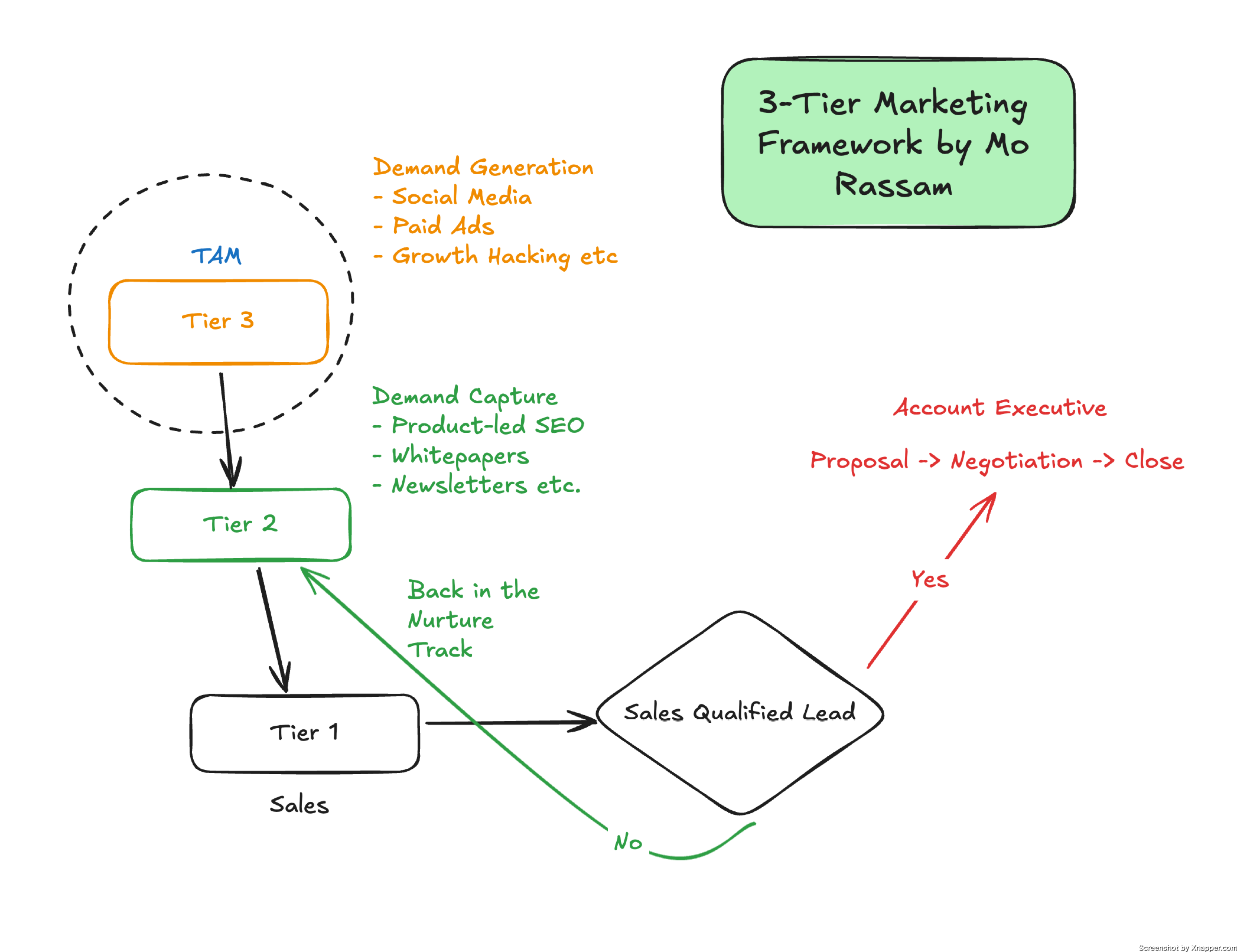
Imagine you are maintaining a Google Sheet of your entire TAM, with their emails, contacts and everything.
Next, you create 3 more Google Sheets:
- Tier 3 - Suspects
- Tier 2 - Informational Prospects
- Tier 1 - Transactional Prospects
Tier 3 - Suspects
People in your TAM who have heard of you. It's hard to find out who exactly they are but a simple proxy is to track who in your TAM follows your company page, connects with your founders on Linkedin or X, subscribes to your newsletter etc.
In simple words, who in your TAM roughly exists in your Universe.
Tier 2 - Informational Prospects
These are the "Suspects" who have risen up a tier by downloading whitepapers from your website, or reaching out to you for more information, or commenting on your Linkedin/X posts for info etc.
The only difference between Tier 3 and Tier 2 is the existence of an "Informational Intent".
Like above, we have proxies available to gauge this intent. To accurately assess this talent is the job of a discipline of Marketing which I'll explain below.
Tier 1 - Transactional Prospects
These are Tier 2s who have levelled up and straight up shown transactional intent by requesting a quote on your website, or DMing you showing clear intent for purchase.
You can occasionally confuse them with Tier 2s but that again is the job of Marketing to figure it out and class your TAM in the right bucket. By the end of this article, you will have clarity on what I mean.
Now, what does Marketing do
The above framework will help you identify what type of Marketing or Marketer do you need at different stages.
Broadly speaking, once you have a Tier 1 Prospect, it's no longer the job of Marketing. You can send them straight to Sales. And if you are low on volume of Tier 1 prospects, give it to the founder. Beyond Tier 1 is all sales.
Tier 2 and Tier 3 is properly the sphere of Marketing. Specifically, two types of marketing: Demand Generation and Demand Capture.
Demand Generation
The only purpose of demand generation is to increase the number of Tier 3s. That means, demand gen marketers need to be experts at virality and distribution.
In terms of marketing activity, demand gen marketers need to be doing a mix of:
- Social Media Marketing (Thought leadership on Linkedin etc.)
- Growth Hacking (Reddit organic posting, etc)
- Content Marketing (SEO, newsletters etc.)
- Performance Marketing (Google Ads, Meta Ads etc.)
And so on.
The tools and means are many. The target is one: Increase the number of ICPs who have heard of our offering.
Demand Capture
The purpose of demand capture is to increase the number of Tier 2s. These type of marketers need to be experts at messaging, generating high-quality content, your solution etc.
Since Tier 2s are "informational prospects" who need information about you, the job of demand capture marketers is to prepare high quality informational material about what you do. And put it in places where the prospects can find them.
In terms of activity, they overlap with demand generation but their purpose and day-to-day work is very different.
While demand gen asks, "How can I reach the broadest possible audience in my ICP?", demand capture asks, "What information does the ICP need that we have not exposed yet?".
The only crucial difference is the "Sales Development Representative" (SDR) role whose job is to reach out to the Tier 3s and "capture" the leads who may actually be in Tier 2 but we don't yet know. And yes, SDR is a Marketing role.
The Big Confusion
I hope you can see now where the confusion begins.
We have two different goals but in terms of activities and terminology, they are kind of the same.
If you hire a Content Marketer, you don't know what exactly they should be doing. It's like hiring a Frontend Engineer and then telling them, "uhh idk, just do whatever ig". You have to assign them a project!
The type of Marketing you need — Content, Performance, Growth, etc — depends on what "channels" make sense for you. The type of Marketer you need depends on which Tier is lacking.
For example, for ColdSend.pro's ICP (B2B Lead Gen Agencies), Linkedin + X is the best combo to increase the number of Tier 3s (or "brand awareness" in other words), because lead gen agencies are doing lead gen on those channels. So that's what I'll be focusing on.
But once I have a Tier 3 in my system, they'll need info and that info they can find most easily via the website. So the second channel is SEO — for levelling up Tier 3s to Tier 2s.
In other words, for demand generation I need a Social Media Marketer and for demand capture, I need an SEO (in my case, I'll be doing both for now, but should the workload expand, I know who I need to hire).
Measure Your Marketer
Now that you have a clear framework to understand what type of Marketer you need to hire, the next step is to measure them on their KPIs.
Very simply:
- Demand generation should be measured on:
- Demand capture should be measured on:
Track both on a monthly basis and hold them accountable on the KPIs. Too many founders make the mistake of tracking things they shouldn't be tracking, like what type of content the marketer is writing or did they use the write font or whatnot. Leave the "creative" stuff to the marketer. Your job as a founder is to hold them accountable on the above metrics. If they are getting the job done, leave them be.
When to Hire a VP/Head of Marketing
As soon as you have 2 marketers — one in demand gen, and one in capture — you should explore hiring a VP/Head of Marketing to oversee their work.
Why do you need a VP?
The biggest problem with the 3-Tier framework is that, while it can help you structure your activities and goal-tracking, it still doesn't tackle the "soft stuff" i.e., definition of your ICP, brand identity, messaging tone, etc.
All of that "soft stuff" that we generally shove under the vague term "Brand" is basically the result of excellent tactical execution that only a solid VP of Marketing can ensure.
I know I said above that as a founder, you shouldn't be wasting time on reviewing the 'creative' stuff because that's exactly the job of the VP to do. You don't want your demand gen to be posting twerking videos to increase followers on instagram. The VP will make sure of that in a way that doesn't stifle the creativity of the marketer.
Moreover, I've glossed over a lot of the tactical stuff like how do you even track the Tier 3s and 2s, does that go into your CRM, what marketing campaigns you should be running, etc. All of this falls under the responsibility of your VP of Marketing.
By the time you have a VP who can make the numbers go up and up, you can leave it to the VP to figure out how or when to scale the marketing team and vie for budget.
Final Thoughts
I've helped companies adopt this framework with almost a 100% success rate. It's not the most comprehensive framework, but it's just good enough that it can help you get started and think more systematically about your growth functions.
In my experience, founders make the mistake of hiring salespeople when they don't have any leads. That is the worst time to be hiring a salesperson. Yes, even an SDR. What is lacking in many cases is demand generation. No one has even heard of you so what impact do you expect an SDR to make?
Theoretically, the SDR can reach out to your TAM via mass cold email campaigns and maybe increase the number of Tier 3s and hence act as demand gen marketer. But that's a terrible use of the SDR's time, not to mention the conversion rates are likely going to be terrible.
The biggest disadvantage a startup has is lack of trust. When no one has ever heard of you, it's very hard to make effective outreach campaigns. It can work, but it's sub-optimal.
In many cases, one of the founders themselves is good at demand gen. Or just good enough to justify an SDR hire. If that's you, by all means go ahead. But if your biggest problem is that no one has heard of you, then you better hire a proper demand gen marketer for it first — one with a track record of virality and distribution.
Confused about which marketer to hire first? We help founders structure their growth function. Let's talk.
Originally published on Substack. Here.