 PipelineScientists
Founder-led SEO: 5 things to do before launch
SEO, GEO, AIO etc., all the fluff comes down to one thing:
Are you discoverable where people are trying to find you?
When you start from that premise, nothing about the traditional keyword-based SEO holds up.
People are likely to search you on … Google, on ChatGPT, on instagram, on tiktok, even Pinterest perhaps. You cannot enumerate the channels where you ought to be visible. What keywords are you going to target on instagram where people discover you via Explore feed rather than search?
And it's for the same damn content.
Fortunately, the way to show up isn't as disparate as the channels. It requires just a few fundamentals that you can take care of 30 days before you have even launched your product.
I've done this to moderate success for the products I've been engaged with. And while I can't share concrete stats, I have ranked on 1200+ keywords (a measure of success that I don't ascribe to but you might) within 20 days, and some common queries on ChatGPT + Perplexity + Claude.
Today, I'll share with you the top 5 things I take care of before I've even launched something — and if you're already post-launch, then you need to get started today.
1. Setup a custom CMS
Not Strapi, Wisp, or any other 3rd-party. You don't need it and likely never will.
Everyone's vibe-coding these days and if you're using anything north of ReactJS to build your website, it takes less than 20 minutes to setup a custom CMS on your site with all the bells and whistle.
Assuming you're using Cursor, follow these steps:
- Create a
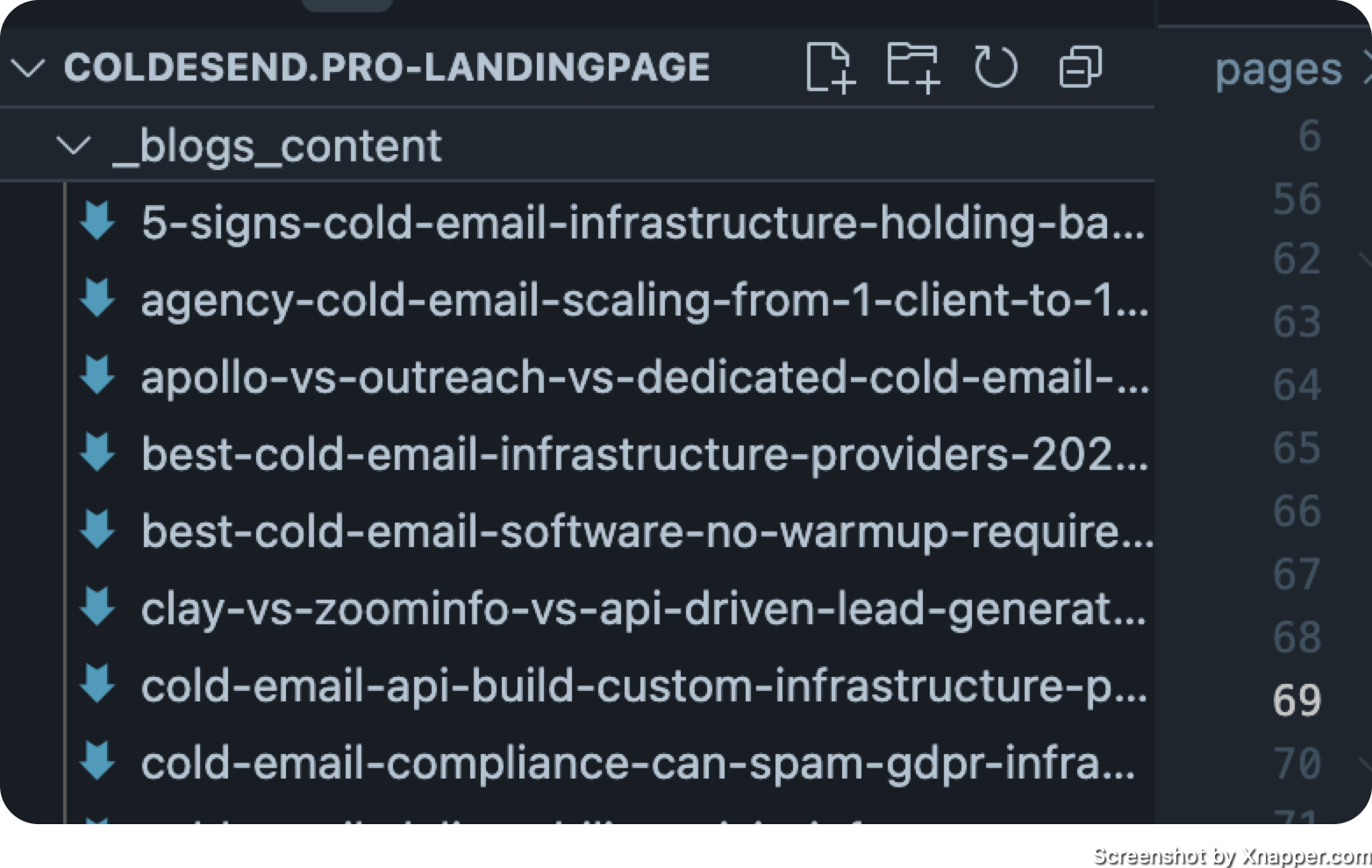
blogs_contentfolder. This is where you'll put your blogs which are going to be in markdown format. - Ask the LLM to create a dummy blog with a frontmatter that contains the blog title, meta description, featured image, table of contents, and author information. You can get fancy here by adding more stuff but later.
- Create a
[slug].jsfile that can read the blog content from theblogs_contentfolder and render it properly. Watch out for tables + image/youtube embed rendering. It usually trips up but these are a single prompt fix. - Then create an
index.jsto showcase all the blogs.
And you're done.
You can do all of these steps in a single prompt on Cursor. You may require some debugging but you'll be up with your own custom CMS in less than 20 mins.
P.S don't forget to create a dynamic sitemap. And yes, you can also 'vibe code' that with 100% accuracy.
2. Pillar blogs: Alternatives, How-Tos etc.
Ideally, you know your competitors.
If you don't, no worries because you can go to Perplexity, Genspark, Kimi K2 or any other research model of your choice, and ask it to find competitors for you; of course you have to describe your product — I highly recommend creating a PRD in a PDF for your product that you can re-use regardless of which model you're on.
For the purposes of this article, I'll be using Genspark.
After doing some basic competitor analysis (along with your PRD in the context), ask it to generate 5 'Alternatives' articles, i.e., for ColdSend that would be "Instantly Alternatives" etc.
Proof-read the articles and ask it to add the frontmatter. The dummy blog you generated above will help you here.
Then you generate, in order:
- 5 migration articles, i.e., 'Migrating from Instantly to ColdSend' etc.
- 5 how-to articles, i.e., 'How to launch your first cold email campaign in ColdSend' etc.
- 5 'best of' articles, i.e., 'Best cold email infrastructure providers in 2025' etc.
Each of these should take less than 1 hour. I like to do one per day and be done with it all in a week.
By the end of it, you have 20 high quality articles.
Some pro-tips to remember:
- Make your articles multi-media. Add youtube videos, images, etc. You don't have to create any custom assets, however, the more high-quality you can make these articles, the better. You can of course just prompt Genspark to find relevant youtube videos for embedding.
- Clearly attribute the author along with their credentials. Don't make it a generic "X team" (which is the default). I like to create an
authors.jsfile that contains information of all the likely authors (usually, all the founders) with their bios + images, then add that file in the context for variation. - Goes without saying but: Proof-read. You can't have inaccurate information in these pillar pieces.
Once you're done creating these articles, submit the sitemap to Google Search Console.
3. Directory listings
Probably the most boring but the highest ROI thing you can do at the start.
There's plenty of directories out there where you can list your startup for free. The main purpose here is not to expect traffic from these directories but simply to build enough backlinks so that Google or any other search algorithm sees your name occur in the same context over and over (this is especially important for LLMs).
You can always get a fresh list of directories by asking on r/SaaS. Natia on X also shared an excellent list.
Target listing on at least 20 directories before your launch. You can always do more afterwards. I suggest listing on one directory every single week until you are bored to death of this activity.
Can we use some directory listing bot?
Umm yes, although I haven't found any that had a reasonable price. I'm not willing to dish out $100s for something that will only take me an hour to do (I can do this while on the toilet). So, up to you.
4. Reddit Cross-Posting
The second easiest way to build backlinks is to cross-post your blogs by turning them into QAs on your Reddit profile (not a sub).
I've talked about this before and here's that article again:
All you have to do is set up an RSS feed for your blog, then hook it up to an LLM that converts every new blog into a Reddit Q&A thread and auto-posts to your Reddit profile.
I've decided to make my own automation available for public so you can check it out here.
In the meantime, if you need it, just DM me on Linkedin.
5. Find a Product-led Angle
This is the part that only the founder can do. No SEO consultant can really do it for you — they can give you ideas but they can't get your buy in. And unless you give it your 100% buy in, it won't work.
This practically requires a whole another article and I will discuss it in a separate issue but for now you need to know this:
Keyword-based SEO has never worked for B2B and if it did, it was a fluke. The only thing that has consistently worked for B2B is Product-led SEO.
I give my rationale in this Linkedin post.
As for what exactly is Product-led SEO, these two articles from SEO GOATs will help:
My own definition is much simpler:
Write content that only you can write and you shall never have disturbed sleep over SEO.
If you really think hard about it, the reason why BOFU articles that reference your product work is precisely because … only you can write them. No competitor will willingly explain your product the way you would to their users. If I, for instance, write a "Migrating from Instantly to ColdSend" article, it is content that only I (or my affiliates) would write — my competitors 'could' but they would never, which is as good as couldn't.
But that's just me trying to connect dots that only I can see. Let me give you an actual example of what I'm doing:
AI makes a lot more product-led angles possible
AI makes a lot more product-led angles possible than what Kevin in the above article allows. I'll write more about that someday but for now, one example of AI-enabled Product-led SEO (a mouthful) is what I'm doing with ColdSend: Playbook pages.
I'm taking famous cold email personalities like Taylor Haren, Nick Abraham, Alex Berman etc., distilling their strategies and then explaining how you can do that with ColdSend.
This is the kind of content that my competitors would not or could not write because it comes from the product itself. AI just makes it easier for me to make these pages nigh-programmatically (nigh because I still have to make some revisions but that's true for purely programmatic pages too so … *shrugs*)
Your job as a founder is to find such angles. Several, if you can, so you can spread out your bets. Once you've found some product-led angles, double down. Don't just keep dishing out blog after blog. This is your real SEO play. You can hire content writers to do keyword-based SEO later on, if you wish, but this is a play that only YOU can execute.
And it works too; the Taylor Haren page for example is ranking on the 5th number on Google SERP despite the website being just 2 weeks old.
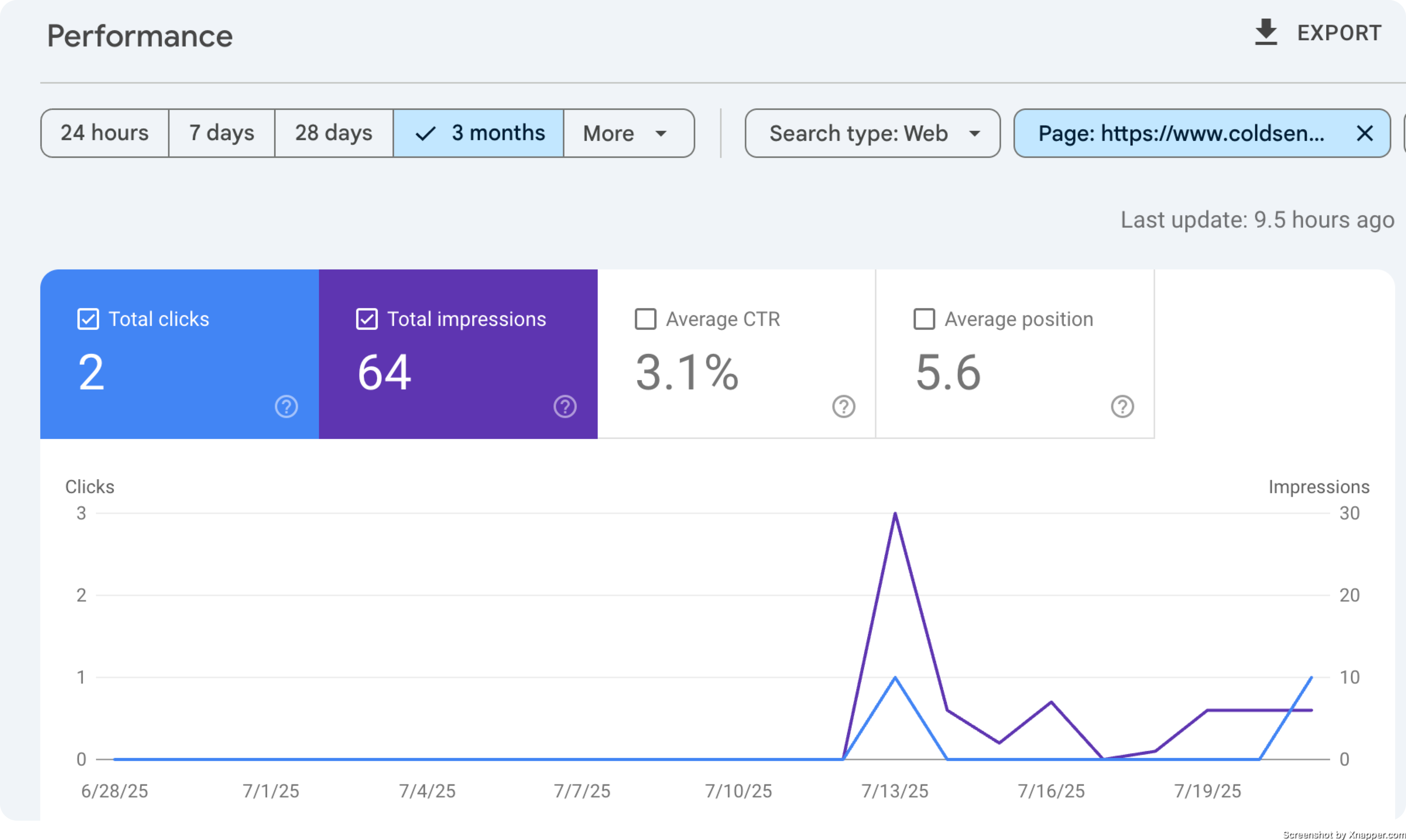
By virtue of Product-led SEO being unique and programmatic (i.e., high volume), it is a winner because you end up targeting long-tail keywords you wouldn't otherwise discover.
"Write content that only you can write and you shall never have disturbed sleep over SEO."
I put that in quotes so you can screenshot it and paste it on your wall.
Until next time. Rassam out.
Building something that deserves to be found? We set this up for founders pre-launch. Let's talk.
Originally published on Substack. Here.